
Our Work Packages
The project will develop a new theoretical framework unpacking the ways in which practised multilingualism may be related to differences in the risk of conflict onset and prospects for conflict settlement.
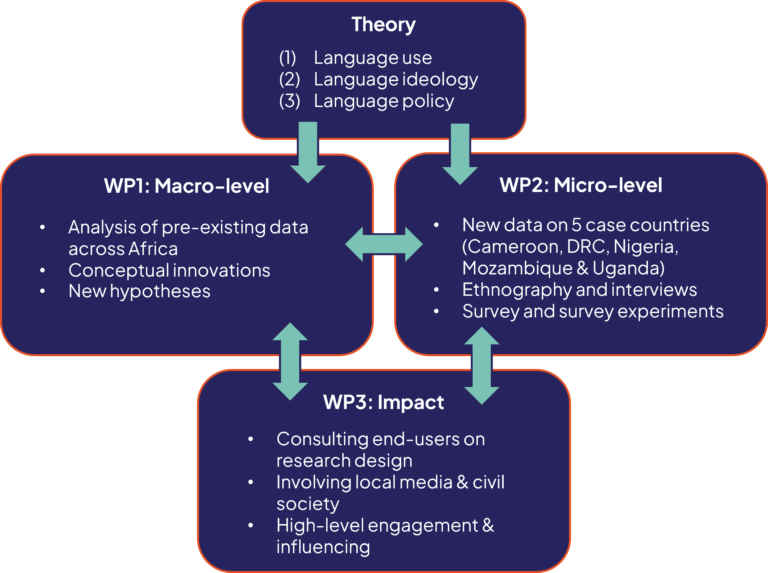
The framework will incorporate three dimensions of practised multilingualism: language use (daily speech practices), language ideology (views about language and their perceived status), and language policy (which languages are promoted and where, and how this impacts social interactions).
The project is organised around three parallel yet interconnected work packages (see figure). These will all start in the first year of the project and run simultaneously throughout. The work packages will have a distinct focus, but are closely integrated, so that the insights in one will feed closely into the work of the others.
Work Package One
Multilingualism and the causes of conflict: conceptual innovations, theoretical propositions, and insights from existing data
This work package will focus on measuring multilingualism and empirically testing the implications of the theoretical arguments for conflict onset and termination. To measure multilingualism, we will review the literature and employ central concepts including multilingualism, language practices, language use, language density, language ideology, and language policy. Although these concepts have been studied for decades, debates continue about their definitions and connections. We will therefore compare existing definitions and consider the best ways to measure or operationalise these concepts, with particular attention to language practices, language policy, and language density, which capture more nuanced aspects of multilingual identities and experiences.
This will provide the basis for the comparative empirical work in subsequent work packages. The conceptual framework may also be adjusted in light of the linguistic ethnography conducted in work package two, as we learn more about individuals’ day-to-day experiences with multilingualism.
Work Package Two
The practice of multilingualism: new qualitative and quantitative information on how speakers might navigate conflict through language use
This work package involves primary data collection combining qualitative methods from linguistics with original surveys and survey experiments from political science. Here, we draw on the extensive quantitative work discussed in prior research, examining the link between language and ethnicity on the one hand, and ethnicity and conflict on the other, as well as the innovations developed in work package one. However, we also take a more nuanced qualitative approach which recognises that speakers are skilled navigators of diverse and rapidly changing linguistic spaces. We seek therefore to examine the connection between multilingual practices and conflict, and the specific causal mechanisms connecting these phenomena.
Our goal in this work package is to comparatively uncover the rich mechanisms through which practices of multilingualism attenuate or worsen conflict. For this purpose, we will focus on five case areas: the DRC, Western Cameroon, Northern Mozambique, Northern Nigeria, and Northern/Western Uganda. These five cases are selected for theoretical and methodological reasons, and focusing on these cases provides particular comparative, causal leverage over understanding the link between multilingualism, conflict, and conflict resolution.
Work Package Three
Multilingualism and conflict resolution: societal benefits, policy and impact
Work package three will be led by co-investigators at ODI Global and will focus on policy engagement, stakeholder outreach and impact. ODI Global will ensure that research across the work packages is informed by practical challenges and stakeholder priorities, contributes to policy-relevant insights, and is translated into accessible, non-academic outputs. This work package will run alongside work packages one and two, engaging stakeholders from the early stages of research through to dissemination. It will have two main components: (1) locally focused engagement and outreach and (2) high-level policy engagement and influencing.
For the first component, ODI Global will work with impact partners situated in-country to ensure that engagement and impact activities are locally relevant and context-specific. In the focus countries, ODI Global and local impact partners will translate research findings into accessible, context-specific activities and materials, such as radio, social media and multilingual materials. Drawing particularly on findings from work package two, they will shape materials for different language communities and assess their reach and diversity of engagement, as well as their influence on audience perspectives and journalistic practice.
The second component will engage policy actors at national, regional and international levels, including, for example, regional organisations, UN agencies, peacebuilding NGOs, and state and civil society actors. A practitioner advisory group will be set up to provide strategic input throughout the project and help connect research findings with policy priorities. This engagement will inform targeted guidelines and policy briefs, which will be discussed through remote, in-person and hybrid roundtables.
At national and sub-national levels, ODI Global will use findings from work package one to shape roundtables, with simultaneous translation where appropriate to support diverse participation. Engagement will culminate in a final workshop for key stakeholders on the findings of the project and outputs will be shared with organisations involved in peacebuilding and peace negotiations across Africa.
Sign up to our newsletter
Stay up to date with the latest news, events, and insights from the MCCRAfrica project.

Get in touch with the MCCRAfrica team
If you would like to get in touch with the project team, discuss our work, and collaborations, please get in touch with Dr Hannah Gibson h.gibson@essex.ac.uk and Dr Florian G. Kern fkern@essex.ac.uk